Selecting a web host is one of the most critical decisions for any digital venture. The choice dictates your site’s speed, reliability, security, and ultimately, its capacity to convert visitors into customers. For decades, one name has dominated the horizon of domain registration and entry-level hosting: GoDaddy.
But dominance doesn’t always equal quality. As we navigate the digital landscape of 2026, the hosting market has matured significantly. Specialized performance hosts, serverless architectures, and AI-integrated platforms are now standard.
So, is GoDaddy Hosting still worth your investment in 2026? Does its reputation as a “beginner-friendly all-in-one shop” hold up under modern scrutiny, or is it a relic thriving on name recognition alone?
This exhaustive 1500-word analysis provides everything you need to make an informed decision. We’ve synthesized technical performance data, analyzed the infamous pricing structures, scrutinized customer feedback, and integrated unique 2026 expert insights to deliver the definitive verdict.
🖼️ Visualizing the Decision
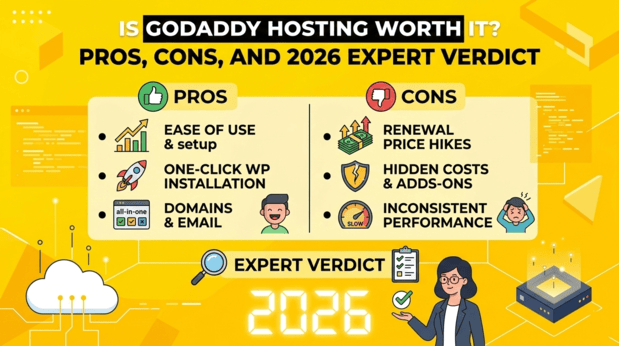
Before we dive into the data, let’s visualize the core debate surrounding GoDaddy: the balance between unmatched convenience and technical limitations.
📈 GoDaddy Hosting at a Glance
For those unfamiliar, GoDaddy is arguably the world’s largest domain registrar, managing nearly 80 million domain names. Leveraging this success, they built a comprehensive suite of digital services designed for total beginners and small businesses.
Their hosting lineup includes:
-
Shared Hosting: Affordable, but resources are shared.
-
Managed WordPress Hosting: Pre-optimized environments for WordPress users.
-
VPS Hosting: More dedicated power and control.
-
Website Builder: An integrated drag-and-drop tool with built-in hosting.
The Bright Side: Top 5 Pros of GoDaddy Hosting 🚀
For millions of users, GoDaddy is the right choice. It excels in key areas that cater specifically to those with limited technical expertise or immediate needs.
1. Unmatched Ease of Use and “One-Click” Setup 💡
This is the single most common praise. The entire user journey is streamlined to minimize friction. Purchasing a domain, connecting it to hosting, installing a content management system like WordPress, and getting your first email address are remarkably simple, often achievable via a single click. Their intuitive, proprietary control panel (alongside cPanel for advanced users) keeps the most frequently used functions immediately accessible.
2. The Power of an All-in-One Solution 🏗️
GoDaddy aims to be the only login you ever need. You can purchase your .com, buy a “Professional Email” address (often a free trial year of Microsoft 365), design a basic site using their builder, launch it on their hosting, and even set up digital marketing tools—all managed from one central dashboard. This unified approach eliminates the complexity of integrating services from multiple providers, which is invaluable for busy entrepreneurs.
3. Reliable Uptime (with a Caveat) ⏱️
GoDaddy consistently achieves a very solid uptime of approximately 99.96% in independent tests. While performance under stress can vary, their network is stable enough for most small business websites, personal portfolios, and blogs that do not have critical real-time traffic requirements.
4. Global Data Centers and Reach 🌍
For international businesses, GoDaddy’s global infrastructure is a significant advantage. With major data centers in North America, Europe, and Asia, they provide respectable loading speeds to users around the world. A site targeted at an Indian audience, for example, will benefit from being hosted in GoDaddy’s Asia-based data center.
5. Advanced Beginner Tools like GoDaddy Airo™ (Unique 2026 Context)
GoDaddy is not ignoring the AI revolution. In 2026, their AI-powered tool suite, GoDaddy Airo™, is deeply integrated. Airo can generate a logo, write basic website copy, suggest social media posts, and even help with basic search engine optimization based on your business description, speeding up the site creation process dramatically for non-technical users.
The Dark Side: Top 5 Cons of GoDaddy Hosting 💰🛡️
GoDaddy’s business model is optimized for high volume and upselling, which creates several significant drawbacks, especially for those who plan to scale their businesses.
1. The Infamous Pricing Trap: Promo vs. Renewal Hikes 💰
GoDaddy’s initial introductory prices are alluringly low—sometimes just a few dollars a month. However, this is a short-term promo. The renewal rate—the price you pay after the first term expires (e.g., after 12, 24, or 36 months)—can increase exponentially, sometimes as much as 70%-114%. The “Economy” shared hosting plan, for instance, might start at $5.99/mo but renew at $11.99/mo. You are essentially locking yourself into a future expense.
2. Essential Features Locked Behind Higher Tiers (Hidden Costs) 🛡️
GoDaddy often excludes features considered standard by modern performance hosts from their lower-tier plans. To get an SSL certificate (critical for security and SEO), daily backups, or even global CDN integration (for faster speeds), you frequently must upgrade your plan or purchase them as expensive add-ons. What looks cheap initially becomes expensive when you add these essentials.
3. Inconsistent Performance under Stress 🏎️
While GoDaddy is “fast enough” for low-traffic sites, it struggles under sustained load or traffic spikes. Shared hosting environments—where resources like CPU, RAM, and disk space are split among hundreds or thousands of sites—suffer from the “noisy neighbor” effect. If one site on your server experiences a surge in visitors, it can drain the resources available to your site, causing significant slowdowns.
4. Aggressive Upselling in the Dashboard 🛍️
Navigating the GoDaddy checkout and dashboard experience is a lesson in resisting temptation. The platform is designed to promote add-ons and upgrades constantly. For new users who do not understand what is optional versus mandatory, this leads to accidental overspending on things they do not need.
5. Inconsistent Customer Support Quality 📞
While GoDaddy offers 24/7 support via phone and chat, the quality of that support is a persistent complaint. Many users report long wait times, agents who follow scripts without understanding complex technical problems, and situations where upgrades or additional paid “expert services” are suggested as the only solution to a problem.
Performance Analysis: Speed, Uptime, and Security in 2026
To understand if GoDaddy is truly worth it, we must look beyond marketing and focus on technical results.
| Metric | Verdict for 2026 | Analysis |
| Uptime (Historical) | Reliable (99.96%+) | Minimal downtime. Stable network for steady-state traffic. |
| Speed (TTFB) | Average (400-600ms+) | Time To First Byte is acceptable but not “performance-grade.” Slower than LiteSpeed-powered hosts. |
| Speed (LCP) | Adequate (1.1-2.0s+) | Largest Contentful Paint is well within Google’s 2.5s recommended threshold, but noticeably slower than optimized competitors. |
| Stability under Load | Waves / Fails | Server response times degrade significantly when more than 50-100 concurrent users are present. Not suitable for flash sales. |
| Storage (Shared) | Decent (25GB NVMe) | Good, modern, fast (NVMe) storage on basic plans. |
| Security | Basic/Locked | Often lacks built-in WAF or advanced malware protection on basic tiers. SSL is frequently an upsell. Malware removal is expensive ($500+). |
2026 Expert Verdict: Who is GoDaddy Hosting Worth It For? 🏁
Is GoDaddy Hosting worth it? The definitive answer is it depends entirely on who you are, what your business needs, and how you value your time.
The experts in 2026 have reached a nuanced consensus. GoDaddy is no longer a viable “one-size-fits-all” recommendation. It is an optimized niche solution.
GoDaddy Hosting is WORTH IT for:
-
Total Beginners (Zero Technical Skills): If your primary goal is to get something online in the next 24 hours without learning how DNS works, GoDaddy is unparalleled. Its convenience cannot be overstated.
-
Small, Static Websites: If you are a local plumber, a small non-profit, or a photographer needing a portfolio—sites that rarely get high-volume simultaneous traffic—GoDaddy shared hosting is stable and sufficient.
-
Low-Stakes Testing: If you need to quickly spin up a site to test an idea for a week before deciding if you should invest seriously.
GoDaddy Hosting is NOT WORTH IT for:
-
High-Traffic E-commerce Stores: Your business’s revenue relies on every millisecond of loading speed and 100% stability during holiday sales. GoDaddy’s instability under load makes it a liability. Choose a specialized Managed WooCommerce host instead.
-
Competitive Blogs Relying on SEO: Google favors performance. A faster host gives you a ranking edge that GoDaddy cannot provide. Essential security and CDN integration costs make it pricier in the long run.
-
Scaling Tech Startups: You need deep server-level customization, custom caching, and scalability that GoDaddy’s rigid architecture and tiered feature system are designed to prevent.
🛡️ Frequently Asked Questions (FAQ)
Here are the most common questions from users navigating the GoDaddy decision in 2026.
1. Is an SSL Certificate included with GoDaddy Hosting?
Often, no, on basic shared hosting plans. This is a primary hidden cost. An SSL might be “free for the first year” and then renew at a high rate ($119.99/yr). Self-Correction: GoDaddy’s Managed WordPress hosting does often include ongoing SSL.
2. Is GoDaddy Website Builder the same as GoDaddy Hosting?
No. Their Website Builder (integrated drag-and-drop tool) includes hosting, but you are locked into their proprietary platform. “GoDaddy Hosting” (shared, Managed WordPress) allows you to use more open-source systems like WordPress, Drupal, or standard HTML sites.
3. Can I upgrade my plan as my site grows?
Yes, GoDaddy makes it simple to upgrade to higher tiers or to VPS hosting. However, the costs associated with these upgrades are often significantly higher than equivalent plans from performance-focused competitors.
4. How long do introductory prices last?
You determine this at checkout. introductory prices apply to the first billing period. If you sign up for 1 month, it lasts 1 month. If you sign up for 3 years upfront (committing a large amount of cash), it lasts 3 years. After that period, the high renewal rate applies.
🏁 Final Recommendation
The choice to host on GoDaddy is a choice of convenience over technical optimization. If you are comfortable spending 15% more money annually on a renewal to save 4 hours of your time during setup, GoDaddy is a good choice. If your business depends on speed, security, and long-term cost efficiency, the answer is a definitive no. 🚀